 SIRUITE DRILLING TOOLS LIMITED

Tungsten Price Volatility (2025–2026): What It Means for Drill Bit Prices, Drilling Costs, and Chinese Exports
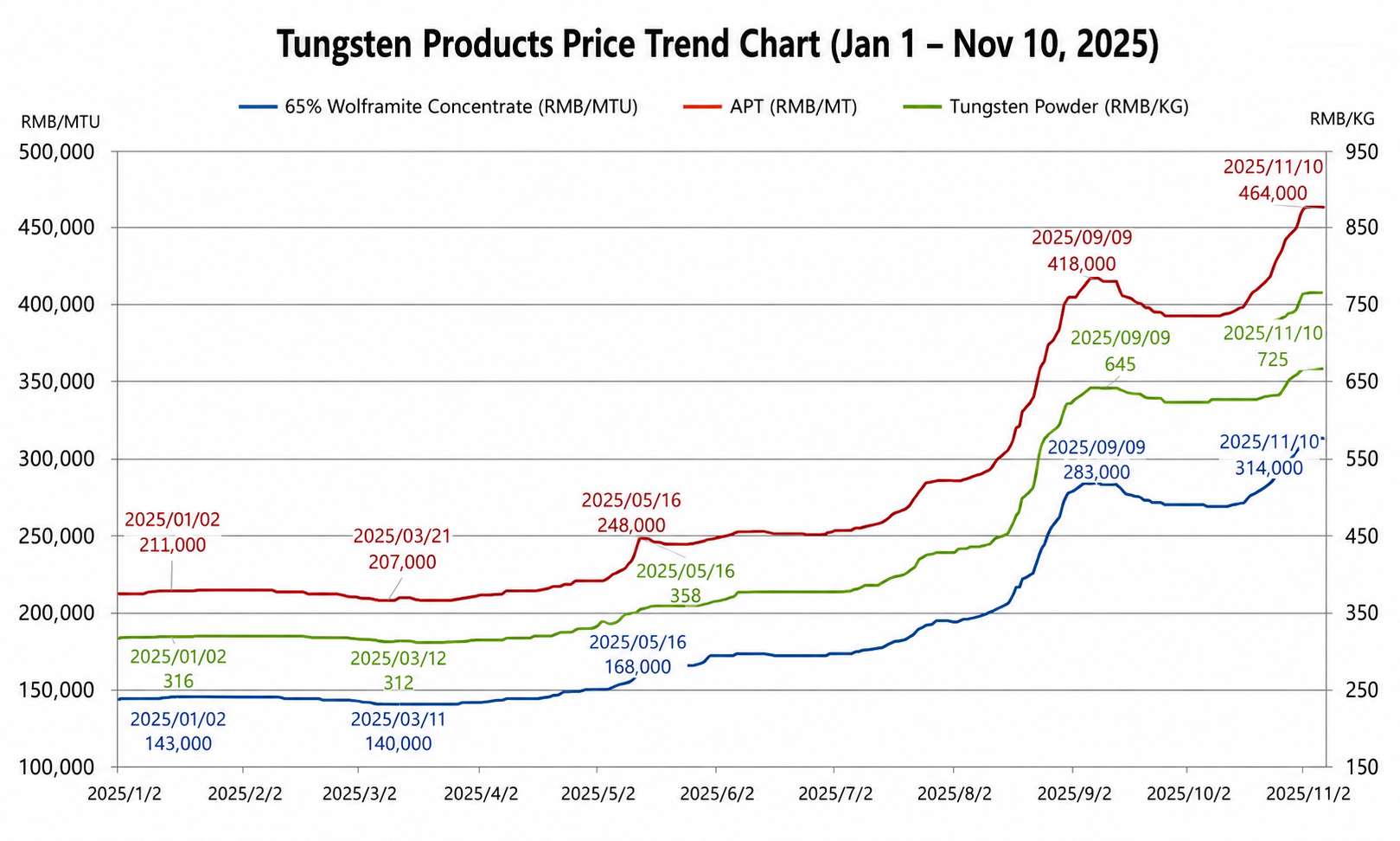
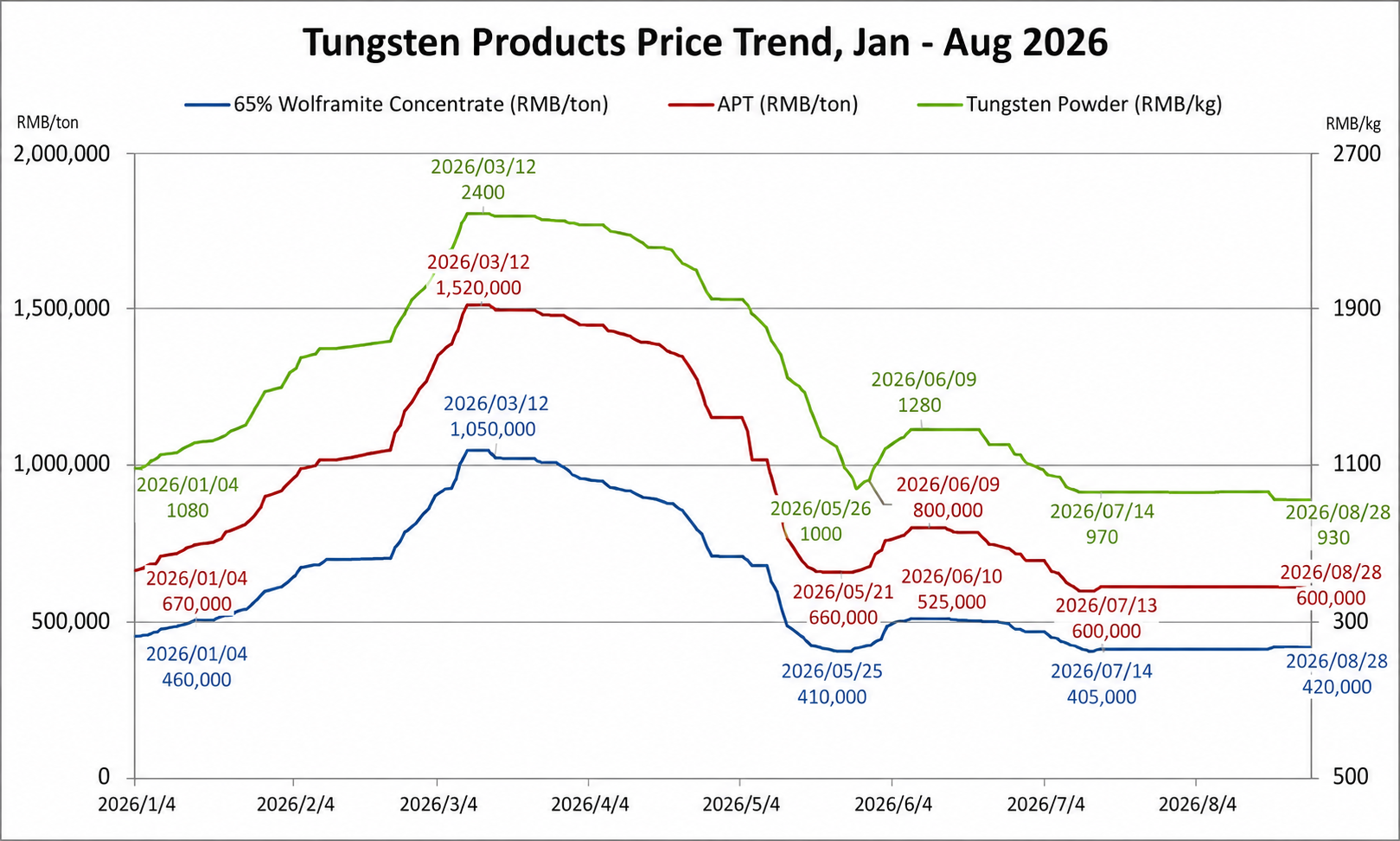
If you buy drill bits — or make them — you've felt this one in your invoices. Starting in April 2025, tungsten prices climbed almost without pause for eleven months, peaked around 2,400 RMB/kg in mid-March 2026, then gave a chunk of that back before leveling out in July 2026. For an industry that has built entire product lines around tungsten carbide, that's not a footnote. It's the reason quotes changed twice in one quarter, why "steel body" started showing up on more spec sheets, and why buyers outside China are waiting longer and paying more to get material out the door.
This post walks through what actually happened to tungsten prices, why it happened, and — the part that matters if you're running a drilling program or sourcing bits for resale — what it did to drill bit costs and to the export pipeline out of China, which still produces roughly 80% of the world's mined tungsten.
The 2025–2026 Tungsten Price Timeline
Tungsten's move wasn't a single spike. It built in stages, and each stage had a different driver.
| Period | Approx. price range (tungsten powder, RMB/kg) | What was happening |
|---|---|---|
| Jan–May 2025 | 316–358 | Market roughly balanced |
| May–Sept 2025 | 358–645 | Environmental shutdowns tightened ore supply |
| Sept–Dec 2025 | 645–1,080 | Trader and processor inventories drained |
| Dec 2025–Mar 2026 | 1,080–2,400 | Export licensing tightened; prices peaked mid-March 2026 |
| Apr–Jun 2026 | Sharp pullback | Domestic Chinese concentrate fell roughly 50% off the March peak |
| Jul 2026 onward | Stabilizing | Prices held in a narrower range through the summer |
Put another way: tungsten roughly quadrupled from where it started in early 2025 to where it topped out about a year later, then gave back a large share of that gain within three months — before finding a new, still-elevated floor.
That last point is easy to miss and worth underlining. "Stabilized" in July 2026 did not mean "back to 2024 levels." It meant the market stopped moving several percent a week. Prices in the second half of 2026 are still well above where they sat before the run-up started.
Why Tungsten Prices Spiked
Four things stacked on top of each other, which is why the move was so sharp.
Ore grades keep falling. The average grade of Chinese tungsten ore has declined for two decades — from roughly 0.42% in 2004 to around 0.28% by 2024 — meaning miners have to move more rock to get the same output. That's a slow, structural tailwind for costs even in a quiet year.
Environmental enforcement cut supply. Chinese authorities shut down more than 60 non-compliant mining and processing operations during 2025, and Hunan province — a core tungsten processing hub — reportedly lost around 30% of its capacity to closures. Mining quotas were also trimmed by an estimated 6–10%.
Export controls concentrated the supply chain. China, which controls both the majority of tungsten mining and the bulk of midstream processing, tightened export licensing on tungsten-related and dual-use items, with a further round of restrictions taking effect in early January 2026. Licenses that once took days started taking months, and material got funneled through a smaller number of state-linked exporters.
Demand didn't slow down to compensate. Defense procurement (tungsten's density makes it a standard material for kinetic penetrators), EV manufacturing, semiconductor and solar photovoltaic production, and cutting-tool demand all kept pulling on the same shrinking pool of material. Several market trackers described this as "rigid" demand — the kind that doesn't back off just because the price doubles.
Layer those four together — tightening ore, enforcement-driven supply cuts, a slower export valve, and demand that wouldn't budge — and a 400%+ move over roughly a year starts to make sense.
How This Hit Drill Bit Prices
Tungsten carbide isn't a minor input for drill bit manufacturers — it's often the single largest line item in a bit's bill of materials, and that share grew as prices rose. Industry data from carbide tool suppliers put tungsten carbide's share of production cost at roughly 45% during the surge, up from about 30% before it began.
The knock-on effects showed up fast:
- Tungsten-heavy PDC (polycrystalline diamond compact) drill bits rose an estimated 20–38% over a seven-month stretch, according to industry reporting on the U.S. drilling tools market. Learn more about our PDC drill bits for water well and borehole drilling.
- One major drill bit manufacturer reported overall manufacturing costs climbing 45–50% year-over-year at the height of the run-up.
- Across the U.S. drilling sector alone, analysts estimated the tungsten price move could add roughly $1 billion to industry-wide drill bit spending in a single year.
Manufacturers responded the way you'd expect: by changing the product. Ulterra Drilling Technologies reportedly shifted its production mix from a roughly even split between steel-body and tungsten-heavy matrix bits to somewhere in the 65–70% steel-body range. Varel Energy Solutions increased its steel-body output share by an estimated 15–20 percentage points. Steel bits use meaningfully less tungsten carbide and cost less to produce — but they generally wear faster and don't hold up as well in abrasive or high-temperature formations, so the switch comes with a real durability trade-off, not a free lunch.
What It Did to the Drilling Industry More Broadly
For drilling contractors and operators, the tungsten story shows up less as a single dramatic event and more as sustained margin pressure. Bit costs are a routine, recurring line item — every rig replaces bits on a regular cycle — so a 20–40% jump in unit price compounds quickly across a drilling program, whether it's oil and gas, water well drilling, mining exploration, or construction/geotechnical work. Explore our tricone drill bits for water well, mining and industrial drilling.
Operators have generally responded in one of three ways:
- Absorb the cost and accept thinner margins, especially on contracts already locked in at older pricing.
- Trade durability for price by switching some or all of their bit fleet to steel-body designs, accepting more frequent replacement in exchange for a lower unit cost.
- Renegotiate around efficiency instead of price — working with suppliers on bit designs, hydraulics, and application-specific engineering that extend bit life and lower the effective cost per meter drilled, even if the sticker price per bit is higher.
None of these is free. The honest summary from people inside the industry has been some version of: there are real trade-offs between durability and cost right now, and pretending otherwise just moves the pain to a different part of the budget.
The Export Side: What Overseas Buyers Are Seeing
This is where things get more interesting for anyone sourcing drill bits — or raw tungsten products — out of China rather than manufacturing domestically.
Domestic and export prices have decoupled. For years, China's domestic tungsten price and its export (FOB) price moved roughly in step, linked by ordinary arbitrage. During this cycle, that link broke down. By mid-2026, domestic Chinese tungsten concentrate had fallen roughly 50% off its March peak, while export-grade APT (ammonium paratungstate) prices out of China stayed elevated — reportedly still up several hundred percent year-over-year on a FOB basis. Traders have described the arbitrage mechanism that used to connect the two markets as "less effective" than it used to be.
Licensing delays are the real bottleneck, not just price. Export licenses for controlled tungsten products have reportedly taken months to process rather than days or weeks, which matters more to a buyer's operations than the headline price does. A higher price you can plan around; an unpredictable multi-month wait is much harder to build a supply chain on.
Foreign buyers have described themselves as supply-constrained, not just price-constrained. Industry sources have characterized mid- and downstream buyers outside China as struggling to secure material at any price during the peak of the licensing slowdown, which pushed some to pay premiums simply to keep production lines running.
Some buyers are hedging by shifting product mix. Just as U.S. manufacturers moved toward steel-body bits, some international buyers have reportedly reverted — at least temporarily — to high-speed steel tooling for applications where tungsten carbide isn't strictly essential, to reduce their exposure to the tungsten market entirely.
For a company that exports finished drill bits (rather than raw tungsten or APT) out of China, this cuts both ways. Finished tools carry more value-add relative to their tungsten content than raw concentrate does, which offers some insulation. But finished-goods exporters still buy tungsten carbide powder or pre-sintered blanks as an input, so cost pressure and, at times, availability pressure still flow through — just with a lag, and usually with less volatility than raw material buyers experience directly.
How to Manage Sourcing Through a Volatile Tungsten Market
A few practical takeaways, whether you're running a drilling program or buying tools for resale:
- Ask suppliers what's actually in the bit. Tungsten carbide content varies significantly between product lines even within the same bit category. Understanding the trade-off between steel-body and carbide-heavy designs lets you make a deliberate cost/durability decision instead of discovering it after the fact.
- Favor suppliers with direct manufacturing relationships. Buying closer to the source — rather than through several layers of trading intermediaries — tends to reduce markup stacking and gives more visibility into lead times, especially when export licensing is a bottleneck.
- Lock in terms where you can. Long-term supply agreements, even informal ones, have helped some buyers avoid the worst of spot-market swings during this cycle. Spot buying works fine in a stable market; it's expensive in a volatile one.
- Price on cost-per-meter, not cost-per-bit. A cheaper steel bit that needs replacing twice as often isn't necessarily cheaper. Track total drilling cost per unit of depth, not just the invoice for the tool.
- Build in lead time for customs and licensing, not just shipping, when sourcing tungsten-containing products from China. The bottleneck during this cycle was frequently paperwork, not production capacity.
Outlook: Where Do Tungsten and Drill Bit Prices Go From Here
Multiple industry price trackers described the tungsten market as "stable" through July and into the following months of 2026 — but stable at a level still well above pre-2025 pricing, not a return to where the market started. The structural pressures behind the surge (declining ore grades, tighter environmental enforcement, and export licensing controls) haven't gone away; what changed is that demand growth and available supply found a new, higher equilibrium rather than continuing to diverge.
For drill bit buyers, that suggests planning around today's price band rather than waiting for a return to 2024 levels. For exporters and manufacturers, it suggests the steel-versus-carbide product mix shifts made during the spike are likely to stick around, at least as an option on the menu, even as pricing eases.
Frequently Asked Questions
Why did tungsten prices rise so much between 2025 and 2026?
A combination of declining ore grades in China, mine and processing shutdowns tied to environmental enforcement, tighter Chinese export licensing on tungsten and dual-use items, and steady demand from defense, EV, semiconductor, and cutting-tool industries all hit at the same time, pushing prices up roughly fourfold over about a year.
How much did drill bit prices increase because of the tungsten price spike?
Reporting on the U.S. drilling tools market put increases for tungsten-heavy PDC drill bits at roughly 20–38% over a seven-month period during the surge, with some manufacturers seeing overall production costs rise 45–50% year-over-year.
Are steel drill bits a good substitute for tungsten carbide bits?
Steel-body bits cost less to produce and buy, which is why several major manufacturers increased steel-body production during the tungsten spike. The trade-off is durability — steel bits typically wear faster in abrasive or high-temperature formations, so they can end up costing more per meter drilled even at a lower sticker price, depending on the application.
Why are export prices for Chinese tungsten different from domestic prices?
China's export licensing controls slowed the flow of material out of the country, while domestic supply adjusted more quickly to falling demand at home. That broke the usual arbitrage link between the two markets, leaving export (FOB) prices elevated relative to domestic Chinese prices for much of 2026.
Has the tungsten market stabilized as of mid-2026?
Multiple industry price reports describe the market as stable from around July 2026 onward, meaning prices stopped moving sharply week to week. That stability is at a price level still significantly higher than early 2025, not a return to pre-surge pricing.
Sourcing drill bits or tungsten carbide tooling from China and want a clear read on current pricing and lead times before you commit to an order? We can walk you through what today's tungsten market means for your specific bit specifications and volumes — reach out and we'll put together a straight answer, not just a quote.